Background
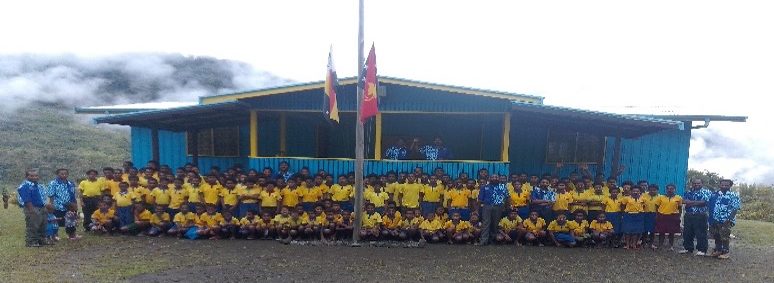
Gumose Primary School is a government agency school. The name GUMOSE is derived from the first two letters of the 3 major villages, Gumbarami, Moro and Sewe which make up Nahu 1 constituency in the Nahu Rawa Local Level Government Council of Rai Coast District in Madang Province.
It is located approximately 40 to 50 kilometres inland of Ramu Sugar township in the easterly direction. It is located upstream, at the head waters of (Nahu River) local name for Gusap River at the foot of the Finisterre mountains. It also lies on the boarder of Morobe and Madang Provinces.
It is very tough indeed, because of the rugged geographical features. Gumose primary school is positioned at an average of 2600 meters above sea level. The place receive rain all year round with fog and cloud cover most of the time.
The rainforest is dense and is uncharted, containing different spices of flora and fauna. The inhabitants of the area are down to earth and hardworking people. They all live a subsistence way of living and work in their food gardens to meet their families, basic daily needs. Gumose Primary School is in existence for 38 years. But some years it ceased operation due to different set-backs.
Culture
The Nahu 1 (Gumose) community share a common culture. Nahu 1 comprises of 3 major villages and 4 other smaller villages. The entire community share a common culture. There are approximately 9,000, Iyo speakers, Iyo language is classified as a Non-Austronesian Language. Buildings in each village, are common, with kunai thatched roofs with a fire place at the centre of the living room. People live a subsistence way of living, with each family working in their own plots of land, cultivating the land to raise crops for their own consumption. Farming method is always bush fallow and a variety of crops are grown in the gardens. People eat sweet potato (kaukau) all year round as their staple food. Other crops are also grown but are seasonal.
Geography and location
Gumose Primary School is situated in isolation to the main centre of Madang. It is located at the foot of the Finisterre Range in Rai Coast District. The climate is cold and humid with cloud cover most often. The locations elevation is up to 2,900 meters above sea level. It is one of the remotest places in Madang Province, with rugged geographical features, which hinders most vital basic services to reach the people of Nahu 1. The fast-flowing Nahu River (Gusap River) runs from the mountains of Rai Coast through the Ramu Valley and empties itself in to the Ramu River. The mountains are very steep and the land slide is common in the area. When the rainfall is high, there is always a chance of landslide to occur in any place where the soil is moisten. Landslide can be destructive and in some case destructions are done to food gardens, villages, foot tracks and even government services. The place has many natural landscapes that are suitable for tourism activities. High mountains, steep sided hills, gorges, waterfall, lakes, mountain valleys and many other features. Variety of fauna and flora are found at the location too and the natural environment is virgin and uncharted.
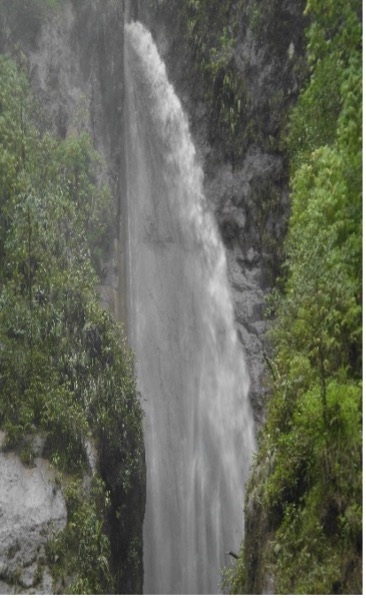
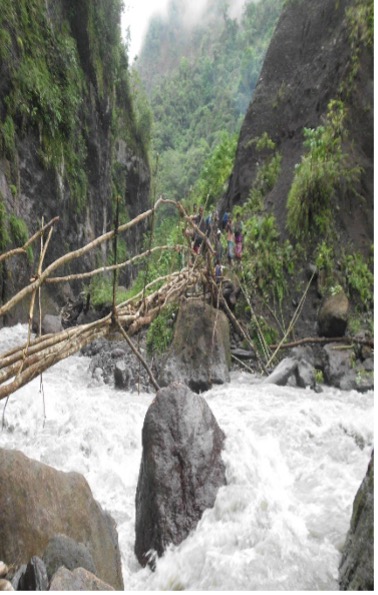
Nahu waterfall and footbridge over the Nahu (Gusap) River
Early form of Education
The migration and settlement of early people in the area is estimated to be around the early 1800’s towards the mid. Since then, the migrants lived without formal education until the establishment of schools by missionaries. The form of education at that time was by observation and imitating the elderly people with verbal transmission of knowledge from elder people to their younger siblings.
The schools were established along the shore line which hindered the people up in the mountains to have the opportunity of being educated and at the same time, they never came in contact with the Europeans. In the mid-20th century, the people of Nahu 1 came in contact with the first Europeans. When the Germans and Australians established their colonial posts in the New Guinea mainland, their Patrol Officers started patrolling the interior of the country.
After the colonial era, the people of Nahu 1 came to know about the importance of education and started sending their children to school. The first group of boys from Nahu 1 were sent to the coast. Students enrolled at schools in Finchafen, Morobe Province and Waping Community School, Saidor Local Level Government in 1954. Due to different reasons, some did not complete their formal education and returned home. All the lads who went away for schooling under colonial rules were not successful, only a few of them succeeded. Some became Lutheran Evangelists, 2 became Aid Post Orderly and 2 became school teachers.
- Late Sir Wiwike Gondengo – First Aid Post Orderly
- Boffenec – Second Aid Post Orderly
- Gimbo – First School Teacher (Qote and Pisin)
- Enariki Koi – Community School Teacher (English)
- Buyuwe Bonguru – Tok-ples skul (Vernacular Education Teacher
- Bondo Gawa- Advocator and Agent of change in Nahu 1.
Tok Ples Skul (Vernacular Education) Kote and Iyo
In the mid-20th century, only vernacular education was established by the Lutheran missionaries in the entire Nahu 1 community. The first vernacular school was established at Moro village south-west of Gumose Primary School. All kids from Nahu 1 were enrolled there. No proper, recognized curriculum was used. The main aim of establishing the vernacular schools was to enable people to become literate so they can read the Bible. Since the students were taught in vernacular, majority of them didn’t have the chance to seek employment.
The school was affiliated with the Lutheran Church, so the teachers usually assess the performance of individual students. The smarter ones were selected and sent to schools which taught English, especially along the coast. There were scares literate persons at that time. The only literate people at that time were Bondo Gawa who completed form or standard 6 at Waping, Buyuwe Bonguru (Tok Ples Skul Teacher and Sikos Yunare (Lutheran missionary’s son).
Summer Institute of Linguistics (SIL) Contact
In the late 70’s, the Summer Institute of Linguistic (SIL) established their translation post in Nahu 1, at Moro village. The locals discussed the agenda of wanting a community school set up in the area, so they negotiated with the SIL Translator, Collin Murphy and his wife Dee Murphy for aid and assistance. Their negotiation was successful when the expatriate couple came back with an application form for a new school.
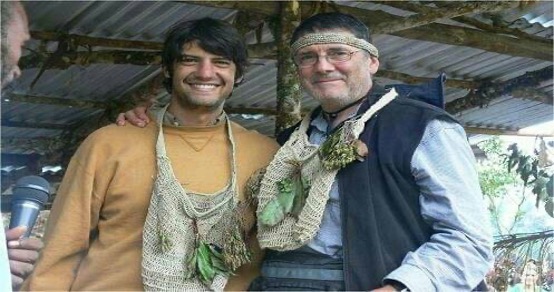
The person who aided the locals to establish Gumose Primary School, Colin Murphy with his son Michael Murphy.
The locals were called and were guided to complete filling the application. Their application was successful and the new school was built at Moro. The newly established school enrolled grade one in 1987 at Moro village south-west of present Gumose Primary school. The local’s interaction with the translator (Colin Murphy) was very good so the expatriate helped to negotiated with the Summer Institute of Linguistic to build an airstrip in Nahu. Gumbarami village was selected to build the aerodrome and in the early 1984 construction of the airstrip began. When the airstrip was completed the school at Moro was than relocated to Gumbarami village for easy movement of teachers and school supplies. Both the airfield and the school were officially opened in 1988 at Gumbarami village.
Establishment of GUMOSE Community School.
In 1987 when the airstrip was completed the people decided to relocate the school to where the airstrip was, so upon agreement the school at Moro village was moved to Gumbarami village and the name was also changed from MOSEGU to GUMOSE community school. The school began with all bush material buildings. As time passed the leaders and the Board of Management team erected simple semi-permanent buildings. The school operated on whatever little funds subsidised by the government as school subsidies. The Board of Management also collected Project Fees from parents and that aided the operation of the school.
Early Operation of the school
In the early years of the school’s operation, things turned out to be good, especially the recruitment of teachers. Teachers from other places were posted to teach at Gumose, the teachers were not aware of the location so they willingly came, but when they discovered the remoteness, they usually left and never returned. This set back caused closure of the school which hinders the progress of teaching and learning. The end results of teachers leaving school was poor academic performance by students both internally and externally.
Despite the problems encountered, Mr Bondo Gawa the Board Chairman never gave up. He consulted the education office for new teachers to take up the teaching position at Gumose. The first grade six examination was conducted in 1992, 8 students were selected to do grade 7 at Brahman High. In September of 1993 a devastating earthquake affected the mountainous areas of Madang and Morobe causing the closure of the school again. The school was suspended due to the earthquake. The residents of Nahu 1 were evacuated to Gusap. People lived in Care Centres at Ramu Sugar awaiting the environment to recover from the damages caused by the earthquake. The school was closed for 3 years (1994 – 1996), no teachers were posted to teach because the foot tracks were completely damaged. Only the locals were able to use the bush tracks.
Early 1997 the school resumed again, Bondo Gawa manage to recruit 2 officers to school. Only the grade 5 and 6 were called to attend class, while the other grades were sent home due to lack of teachers on the ground. The same happened through to 1999. In year 2000 to 2002 the school ceased operation again because the Board Chairman (Bondo Gawa) left for PortMoresby and there was no one in the community who can afford to fetch teachers from Madang. The poor students were deprived of our rights to education, I Gawa Ronuka was one of the victims.
The school resumed again in 2003 with 4 teachers recruited to school. Mr Bondo Gawa returned from Port Moresby and continued his work as chairman again. Since the Nahu 1 community had experienced such hardships, they worked in extremes to fetch teachers, especially the Board Chairman, Mr Bondo Gawa. He asked the people in authority at the education office in Madang for alternatives so he can send locals to Teachers’ College. His supplication was a success where the Madang Division of Education under the administration of Late Christopher Bulu and Late John Ura negotiated with the Madang Teachers’ College administration and came to an agreement.
The college conducted grade 10 Lahara programs which enrolled grade 10 drop-outs from remote places in Madang province. That paved way for locals who left school at grade 10 to go to college. At this very point 4 grade 10 dropouts were enrolled and attended college and graduated as primary school teachers, (Henu Gurunonge and Sipar Koteke in 2009, Ganango Buyuwe in 2010 and Gawa Ronuka in 2012. Sipar Koteke left after serving the community for only 2 years, while the other 3 officers are faithfully serving Nahu 1 community (Gumose Primary School). The outcomes of the local officers sacrificing to serve their school with the help of officers from other places, tremendous improvements had occurred. Below list highlights some areas that we have achieved positive outcomes.
- academic performance improving
- school taking its current shape and status
- infrastructural development and improvement
- students from Gumose graduating from higher institutions
Two of our male students graduated from teachers’ college and joined us, Timothy Esanange and Dondi Ririmo. Others graduated from other institutions too during our term of service at Gumose Primary School. With the above achievements, we are planning ahead to cope with the current transitional plans of the Education Department.
Current school status
Gumose Primary School was a level 4 school but, recently under the position elevation and school status elevation, the school was elevated to level 5. There are 12 funded positions at the school. We have started implementing the 1-6-6 school structure by taking on board grades 1 and 2 into the primary school.
Students Enrolment: (Population)
The three Preparatory Schools that feed Gumose Primary School includes, Gumbarami, Gumose and Sewe Pre Schools. Each year they feed Gumose Primary School with students to enrol at grade 3.
They send, 15 to 20 students depending on their learning capabilities. They are being advised not to send the entire grade two class, but to do screening and select only the ones who meet the benchmarks set by the Department. Lately Gumose Primary School enrolled 250 plus students, but this year 2025, the figure of enrolment fluctuated to 300 plus students. We are expecting the population to increase in the years to come. We have stream classes for grades 3 and 4 and will surely continue on to the other grades as we progress into the future.
Students and teachers.
Teaching Staff
There are 12 funded positions at Gumose Primary School, and 7 of the positions are occupied by local officers while the other 5 are taken up by officers from outside. Due to less number of students and the classes, some of the positions are usually being borrowed by other schools who need positions.
Currently there are 7 officers on the ground with 3 helpers who volunteer to assist with the grade 1 pupils, raising the total number of teachers up to 10. They are being paid allowances by the Board of Management of the school on termly basis, using the funds raised from school projects.
Five of the officers are locals and passed out from Gumose Primary School and have returned to teach at their school since they graduated from college.
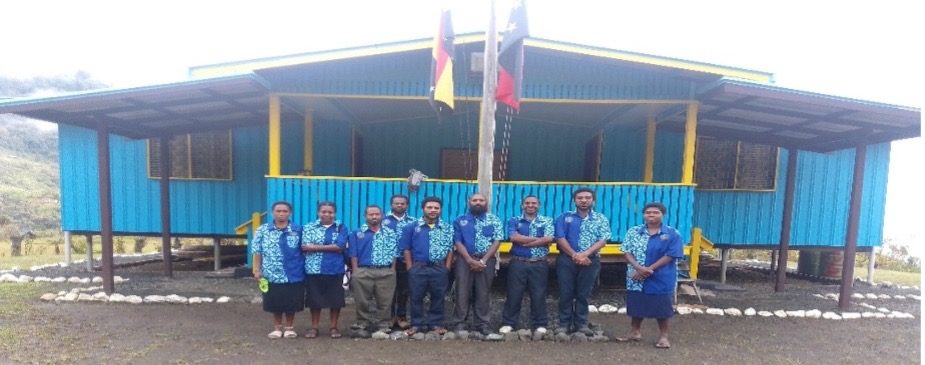
The teaching staff (2025)
Infrastructure
In terms of infrastructures, most of the school buildings are semi-permanent and many are of bush materials. The past administration of the school operated without a SLIP (School Learning Improvement Plan) and so funds were used unwisely, resulting in lack of proper permanent buildings at school. In this current administration, all parties have gathered and have produced a SLIP that is in use. The managing body is now utilising the Tuition Fee Free (TFF) funds allocated each year to implement the 3- year SLIP plan. According to the SLIP plan, we realise and discovered that we have achieved some of our plans such as, the erection of the school administration, Library building and 3 staff houses. The Board of Management is planning to construct a double classroom and two staff houses in the coming year, 2026, if funds are sufficiently available. The current Board of Management is keen in putting in place all the necessary facilities so we can be able to cope with the transitions occurring in the education system of the country.
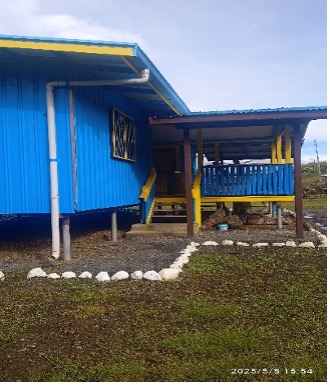
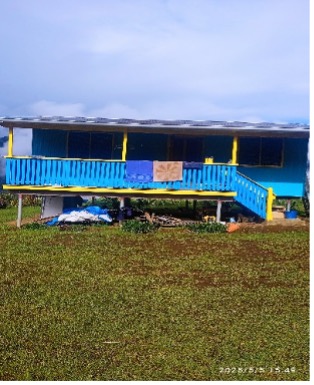
New infrastructures at school
Tuition Fee Free (TFF)
Tuition Fee Free (TFF) funds are received each year. Gumose Primary School lack problems with the yearly and quarterly payments of the Tuition Fee Free funds. It is obvious that, each year, Census Forms and other necessary reports are always filled and submitted on time. This enables the school to receive funds each year on quarterly basis. Acquittal reports are compiled and submitted to the responsible authorities, after spending the funds accessed from the school account. Despite the fact that the funds received each year is insufficient to cater for infrastructures and the teaching and learning materials, the Board of Management on tight and strict budget have managed to bring forth some major physical changes in school. Ever since establishment of this school we have never received any forms of funds from other sources, until 2021, the school received a sum of K45,999.99 from the Rai Coast District Development Authority and also a K 19,200 was donated by Wood Butter, an organisation in the United States of America. The management team carefully utilised these funds with the TFF funds and erected the buildings mentioned earlier above. With these achievements, the Board of Management is confident that more improvements are expected in the future.
Board of Management (BOM)
The Board of Management is active with 13 members, 4 from each village, each representing the different denominations in each village. The Board of Management executives were changed 3 years ago, where Esanange Qotenue was appointed the new Chairman, replacing Bondo Gawa. Other changes were also done to the executives. The table below contains the Board members and their roles.
| No. | Name | Design | Village | Denomination | Role |
| 1 | Esanange Qote | Chairman | Sewe | Lutheran | Exec |
| 2 | Sesinu Buyuwe | Vice Chair | Moro | Baptist | Exec |
| 3 | Dokone Bome | Treasurer | Gumbarami | COC | |
| 4 | James Tipe | Member | Moro | COC | |
| 5 | Rofore Bufu | Member | Sewe | EBC | |
| 6 | Neps Basa | Member | Gumbarami | Lutheran | |
| 7 | Nelson Siri | Member | Moro | COC | |
| 8 | Yupemu Heitch | Member | Sewe | Lutheran | |
| 9 | Upike Penare | Member | Gumbarami | Lutheran | |
| 10 | Poman Yuro | Member | Moro | Lutheran | |
| 11 | Puruyu Ririro | Member | Sewe | Lutheran | |
| 12 | Yuyukao Wise | Women Rep… | Nahu 1 | Lutheran | |
| 13 | Ronuka Gawa | Head Teacher | Gumose | COC | Exec |
Community Involvement and Government Services.
The people of Nahu 1 are very helpful, respectful and down to earth people. They are cautious about the government services they have in their community. Mondays are used as government days in which the community organises its members and uses it to work in the government services.
When there is, insufficient funds to charter planes to ship school materials, the people willingly and voluntarily fetch them to the school from Ramu Sugar. When the Board of Management have enough funds, they pay for labour at a cheaper rate. Otherwise the people don’t demand for labour payments. These includes supplies of any services that are established in Nahu 1. The basic government services instituted at Nahi 1 includes:
- Gumose Primary School
- Gumose Pre School
- Gumbarami Pre School
- Sewe Pre School
- Moro Aid Post
- Gumbarami Sub-Health Centre
- Nahu 1 Airstrip
- Water Supply in all Nahu 1 communities.
- SIL Translation (Iyo Language) NGO’s
Most of the government services are located at Gumbarami village, because the land feature at Gumbarami is flat and stable to cater for developments.
Means of transport in Nahu 1
Transportation has been a major obstacle, since establishment till present date. There are no roads linking Gumose Primary School. It is only accessible through the traditional bush tracks and air, that both the locals and the public servants use to deliver basic services to the Nahu 1 communities which Gumose Primary School serves.
When the Board of Management fetch teachers and school supplies from town, despite the fact of encountering difficulties, they manage to bring them into the community. When we have sufficient funds, we charter (SIL) planes to transport the materials to Gumose Primary School. Each charter costs us around 4 to 5 thousand kina per flight. It is only the Summer Institute of Linguistics (SIL Aviation) who aid us with flights. Other Aviation companies don’t assist us with flights so it’s difficult in terms of transportation. Air plane fares differ from locations, example from Aiyura where SIL Aviation is located to Nahu is K350, from Gusap to Nahu is at a cost of K290 and from Madang to Nahu is at K450. Commercial flights can also be scheduled, but it depends on the quantity of cargoes and passengers, front and back loads must be considered. When there is enough cargoes and passengers to cover the maximum loads the aircraft can carry, the SIL Aviation allow flights and include us in their schedules, but otherwise we are denied.
With other aviation companies we lack contacts therefore we don’t engage them to make flights to Nahu Airstrip. Otherwise, if we enquire for flights, they may include us in their schedules and help as well.
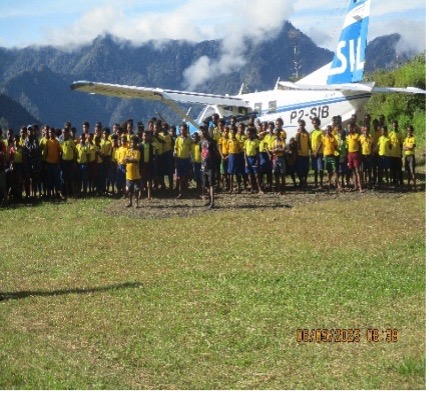
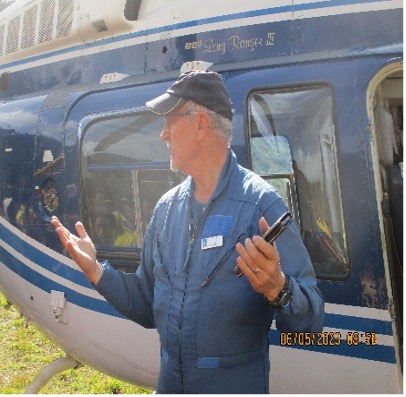
SIL Aviation Aircrafts
Future Plans
The school’s administration is keen in putting up permanent buildings to cater for teaching and learning to take place in a more secured and conducive environment. Due to the fact that the population in the area is increasing rapidly and the enrolment at Gumose Primary School is accumulating each year. The people are informed of the changes that are planned to take place in the education system of the country and so the people don’t want to be left behind.
Therefore all parties responsible are urging the Board of Management to utilize the available funds each year to erect the required infrastructures, to cope with the coming changes. The community is proposing to have a Junior High School set up at Nahu 1, so their kids can be educated in their own place instead of going to boarding schools far from home.
